Marketing is undergoing a structural shift. For decades, campaigns have been the backbone of marketing execution.
Teams planned, launched, optimized, and repeated. But in 2026, this model is becoming obsolete.
Artificial intelligence is not just accelerating campaigns. It is replacing them with something far more powerful: systems.
AI-native marketing organizations are moving away from one-off initiatives and toward always-on, self-optimizing ecosystems that continuously generate demand, personalize experiences, and drive growth.
This article explores what that shift means, why it matters, and how to build an AI-native marketing organization.
The Problem with Campaign-Based Marketing
Traditional marketing campaigns are inherently limited:
- They are time-bound
- They rely heavily on manual execution
- Optimization happens after the fact
- Insights are often siloed
Even the most sophisticated campaigns struggle to keep pace with real-time consumer behavior. By the time a campaign is fully optimized, the market has already shifted.
What Is an AI-Native Marketing System?
An AI-native marketing system is an interconnected, always-on framework that uses data, automation, and machine learning to:
- Continuously generate and test creative
- Dynamically allocate budget across channels
- Personalize messaging in real time
- Predict and respond to customer intent
Instead of launching campaigns, AI-native teams design systems that run indefinitely and improve autonomously.
Think of it this way:
Campaigns are events. Systems are infrastructure.
Core Components of an AI-Native Marketing Organization
1. Unified Data Layer
Everything starts with data.
AI-native organizations consolidate first-party data from CRM systems, website behavior, ad platforms, and customer interactions into a single, accessible layer.
This creates a real-time understanding of the customer journey and fuels every downstream decision.
2. Continuous Creative Engine
Instead of producing a handful of ads per campaign, AI systems generate and test hundreds or thousands of creative variations.
These systems:
- Identify winning patterns
- Adapt messaging based on audience behavior
- Refresh creative automatically to prevent fatigue
Creative becomes a living system rather than a static deliverable.
3. Autonomous Media Buying
AI-driven platforms now handle:
- Budget allocation
- Audience targeting
- Bid optimization
4. Real-Time Personalization Layer
AI-native organizations deliver personalized experiences across:
- Websites
- Ads
- SMS and messaging platforms
Every interaction is informed by behavior, intent, and predictive modeling.
This transforms marketing from broadcasting to individualized engagement at scale.
5. Feedback and Learning Loops
The defining feature of a system is its ability to learn.
AI-native marketing systems continuously ingest performance data and refine:
- Messaging
- Targeting
- Channel mix
This creates a compounding effect where performance improves over time without requiring manual intervention.
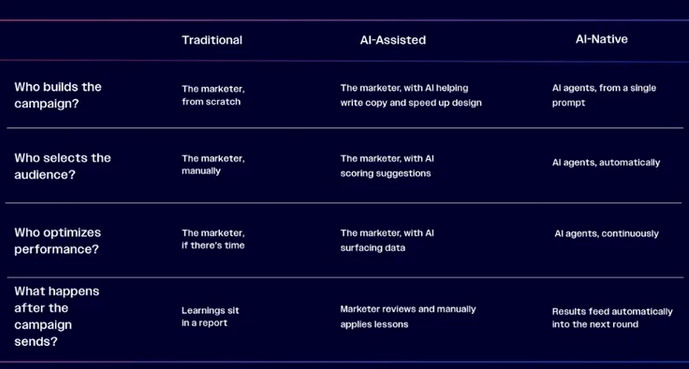
Organizational Shift: From Roles to Capabilities
Building an AI-native marketing organization is not just about tools. It requires a shift in how teams are structured.
Traditional Roles
- Media buyers
- Copywriters
- Campaign managers
AI-Native Capabilities
- System architects
- Data strategists
- AI prompt engineers
- Growth operators
The focus moves from executing tasks to designing and managing systems.
Benefits of AI-Native Marketing Systems
Organizations that make this transition gain several advantages:
1. Speed
Decisions and optimizations happen in real time.
2. Scale
Thousands of variations can be tested simultaneously.
3. Efficiency
Manual workload is reduced significantly.
4. Performance
Continuous optimization leads to compounding returns.
Challenges and Considerations
Despite the upside, the transition is not without challenges:
- Data quality and integration issues
- Over-reliance on automation without strategy
- Brand consistency risks with AI-generated content
- Internal resistance to change
Successful organizations balance automation with human oversight.
How to Start Building an AI-Native Marketing Organization
Step 1: Audit Your Current Stack
Identify gaps in data, automation, and integration.
Step 2: Centralize First-Party Data
Invest in systems that unify customer data across touchpoints.
Step 3: Introduce AI in High-Impact Areas
Start with:
- Creative generation
- Media optimization
- Personalization
Step 4: Build Feedback Loops
Ensure every system captures and learns from performance data.
Step 5: Upskill Your Team
Train your team to work with AI tools and think in systems rather than campaigns.
The Future: Marketing as an Autonomous Growth Engine
The end state of AI-native marketing is not just efficiency. It is autonomy.
Organizations will operate marketing ecosystems that:
- Generate demand continuously
- Adapt instantly to market changes
- Deliver hyper-personalized experiences at scale
Campaigns will not disappear entirely, but they will become just one input into a much larger system.
The shift from campaigns to systems is one of the most important transformations in modern marketing.
AI-native organizations are not simply doing marketing better. They are redefining what marketing is.
The question is no longer whether to adopt AI, but how quickly you can transition from executing campaigns to building systems that drive continuous growth.