
Billboard advertising has been declared dead so many times that the claim has become a cliché. First the internet was supposed to kill it, then social media, then mobile ads. Yet billboards are still standing on highways and city streets, and businesses of every size still use them to get noticed.
The real question is not whether billboard advertising still works. It does. The question is whether it is the right tool for your business, your audience, and your goals, and how it fits into a strategy that also includes digital channels. This guide covers where billboards came from, what they do well, where they fall short, and how to get the most out of a campaign in 2026.
A Short History of Billboard Advertising
Putting messages in public places is one of the oldest forms of advertising. Traders in ancient Egypt and Greece carved notices into stone, and hand-painted signs were common in Europe by the 1700s.
From painted signs to digital screens
The modern billboard took shape in the 1800s, when lithography made large, colorful posters affordable. The first standardized billboards appeared in American cities in the late 1800s, and as cars filled the roads in the early 1900s, roadside signs became one of the most popular ways for brands like Coca-Cola and Ford to reach the public. Standard sizes followed in the 1920s.
Later decades brought weather-resistant vinyl, computer-designed graphics, and, finally, digital billboards that can rotate several ads, change messages in real time, and target by time of day. The format has changed a lot, but the idea is the same: a short, striking message that people see in seconds.
Do Billboards Still Work in 2026?
Yes, with some important qualifications. Billboards work best for broad awareness, local brand building, and reaching people in a specific area. They work less well for direct response, precise audience targeting, and conversion tracking.
Why billboards still get noticed
- They can’t be skipped. A driver can’t install an ad blocker, scroll past, or close a billboard. In busy locations, your message is seen again and again.
- They reach everyone who passes. Commuters, pedestrians, and visitors all see the same message, which makes billboards strong for building broad brand awareness.
- They target by location. Placing a billboard near a highway exit, a city center, or your own business puts your message in front of the people who are most likely to visit.
- They build credibility. A well-designed billboard signals that a business is established and here to stay, which supports your brand reputation.
- They cost less than TV or radio for the number of people reached, especially for local and regional businesses.
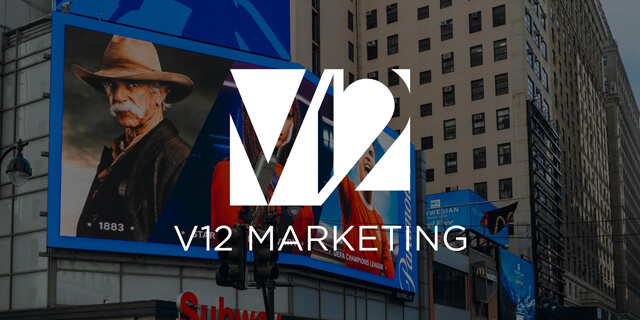
We see this in our own work. The billboard below is one of our campaigns here at V12 Marketing. Its location at a busy intersection, seen daily by commuters and pedestrians, is a big part of why it works.

Where billboards fall short
The limitations are just as real. Attention spans are short, so a billboard may only hold someone’s eye for a second or two. You can’t retarget someone who saw your billboard; you can’t A/B test a design with real precision, and you can’t reliably tie a sale to a single billboard view. Prime locations can be expensive, and there are environmental concerns with traditional vinyl. For businesses that make every marketing decision based on trackable ROI, these gaps make billboards harder to justify on their own.
What Makes a Billboard Ad Effective
The biggest creative limit with billboards is time. A driver passing at highway speed has about three seconds to see, read, and understand your message. That shapes everything about a good design.
Keep the message to seven words or fewer
Focus on one idea. Let the image do most of the work, with bold colors and strong contrast that catch the eye before anyone reads the headline. Keep text short, and make your logo and brand name large enough to read from a distance. If someone has to think about what you’re advertising, the billboard has already lost them.
Give people one clear action
Tell viewers exactly what to do next. A specific offer like “Free estimate, call today” or “New location now open” works better than a general brand message. Phone numbers are often easier to remember from a moving car than website addresses, and a QR code works well on billboards people see while walking or waiting at a light.
Learn from campaigns that worked
Apple’s “Shot on iPhone” billboards showed real photos taken by real customers, which proved what the product could do and got people talking. McDonald’s “Follow the Arches” campaign used pieces of its famous logo as arrows pointing to the nearest restaurant. Both campaigns kept the design simple and let one strong idea carry the message.
Where to Place a Billboard
Location matters as much as design. A billboard’s value depends almost entirely on how many people pass it and whether those people match your target audience.
Highway vs. neighborhood locations
Highway billboards reach the largest audiences, but many of those drivers are just passing through. That reach is valuable for brands with broad appeal and can be wasted on a business that serves one local market. Neighborhood and city placements reach fewer people, but those people live, work, or shop nearby and are more likely to act.
Place it near the point of decision
The best placements are close enough to your business that someone who sees the ad can act right away. A billboard for a coffee shop one mile before the exit will outperform the same billboard ten miles away. For a business that sells to other businesses, a location in a business district or along a commuter route puts the message in front of decision-makers. Always start by asking where your audience physically is and where they’re going.
How Billboards Fit a Multi-Channel Strategy
In 2026, billboards work best as one part of a plan where every channel supports the others, not as a standalone tactic.
Billboards make digital ads work harder
Someone who has seen your billboard is more likely to click your Google Ads when they search for what you sell, more likely to recognize your brand in a social media feed, and more likely to trust your website when they land on it. Research shared by HubSpot and others points to the same pattern: people remember a message better when they see it across several channels.
Connect offline and online
Give people an easy way to move from the billboard to your business online, with a QR code, a short web address, or a social media handle. Back it up with strong local SEO and content marketing, so that when someone searches your business name after seeing your billboard, they find a complete Google Business Profile, good reviews, and a helpful website. Digital billboards make this even easier, because you can run the same design on the billboard and in your promoted social content at the same time.
How to Measure Billboard Results
Measurement is the biggest challenge with billboards. There is no click and no cookie, so you can’t track a single view to a single sale. You can still build a clear picture of whether a campaign is paying off.
Four practical ways to track impact
- Use a unique phone number or web address that appears only on the billboard, so every call or visit can be traced back to it.
- Watch branded searches in Google Search Console before, during, and after the campaign. More people searching your business name is a strong sign of awareness.
- Ask new customers how they heard about you, on your contact form or during the first call.
- Track calls and visits from the area around the billboard while the campaign runs.
None of these methods is as precise as digital tracking, but together they show whether the billboard is earning its cost. Mailchimp’s guide to billboard advertising covers more ways to plan and measure a campaign.
Is Billboard Advertising Right for Your Business?
Billboards are not for every business or every budget. The right answer depends on who your customers are and what you need your marketing to do.
When billboards make sense
Billboard advertising is a strong fit for businesses with broad local or regional appeal, physical locations that benefit from local awareness, and budgets that can support a billboard for several months rather than a short run. Local businesses use them to stand out in their community, and startups use them to get noticed in crowded markets.
When to put your budget elsewhere
Billboards are a weaker fit for businesses with a very narrow target audience, businesses that need every dollar tied directly to measurable leads, and businesses with small budgets. In those cases, search ads, social ads, and local SEO usually deliver more for the money.
For most businesses, the answer is not billboards or digital. It’s understanding what each channel does for your customers and building a plan that brings them together.